Fixed scope, fixed price. You get a short, plain-language report — not a black box.
// launch pricing — the launch rate applies to the first clients. A testimonial is welcome, never required.
› Server Hardening
from €179 / server · launch price (€299 after)
Problem. A server you inherited or set up quickly: you don't know what is exposed, and you want it fixed — not just described.
- Initial assessment: what is exposed, and what is worth changing
- Implementing the changes agreed in writing — SSH keys only, default-deny firewall, fail2ban, automatic updates, sysctl values that fit the host
- Verification after each change, before the next one
- Before/after report, with the evidence for each setting
- Optional: Nginx, TLS, Docker, monitoring
Evidence: a worked lab report, plus the two open-source tools below.
You receive: a written before/after report, the raw evidence, and the rollback step for each change — or the reason it has none.
Rollback: each change is listed with its rollback step, or with why it has none. Full reversal depends on the snapshot taken before the work and on what the change touched — where a clean rollback is not possible, the report says so before the change is applied.
Not included: application code review, compliance certification, 24/7 monitoring, changes outside the agreed window.
Next step: tell me the OS, what runs on it, what must not change, and when a change window is possible.
./harden-my-server
› Self-Hosted n8n
from €400 · launch price (€650 after)
Problem. Cloud automation bills every month and keeps your data on someone else's servers.
- n8n on your own server (Docker + Postgres + TLS)
- Host hardened first — and no monthly SaaS fee
- Backup and a restore procedure you can actually test
- Workflows: form → CRM, invoices, reminders, AI summaries
- Migration from Zapier/Make for the agreed workflows
Evidence: a lab summary and one illustrative graphic — no configuration, workflow exports or logs are published.
You receive: a running instance, documented access, the backup/restore steps, and the agreed workflows.
Not included: workflows you have not specified, third-party subscriptions, data migration beyond the agreed list.
Next step: list the workflows and where the data lives today.
./set-up-my-n8n
› MCP / Agent Security Review
from €99 · launch price (AI audit + agent hardening)
Problem. An agent or MCP server can usually reach more than you think, and the tool descriptions it reads are part of the prompt.
- MCP servers: exposed? authenticated? least-privilege? (default-deny, not
0.0.0.0)
- Tool descriptions that carry hidden instructions — checked by hand, with the raw catalog output
- Blast radius: which read tools pair with which write/egress tools (that's your exfil path)
- Audit trail design — how a tool call is logged and attributed
Evidence: the poisoning lab and the scanner below.
You receive: a written report — what is exposed, the top 3 fixes, how to verify each, and the scanner output for your catalog.
Not included: a guarantee that an agent cannot be manipulated, code fixes, compliance certification, penetration testing.
Next step: name the server or integration, and what the agent is allowed to touch.
./review-my-agents
Evidence you can inspect
Each item is public: a report, a repository, or a lab write-up. Where a public artifact does not exist, the entry says so.
hardening reportLab. A Fedora container I hardened for the write-up.
Read it ↗
Shows: the report format, the output attached to each setting, and the drop-in override trap.
Does not show: a client engagement, or that any specific server is secure.
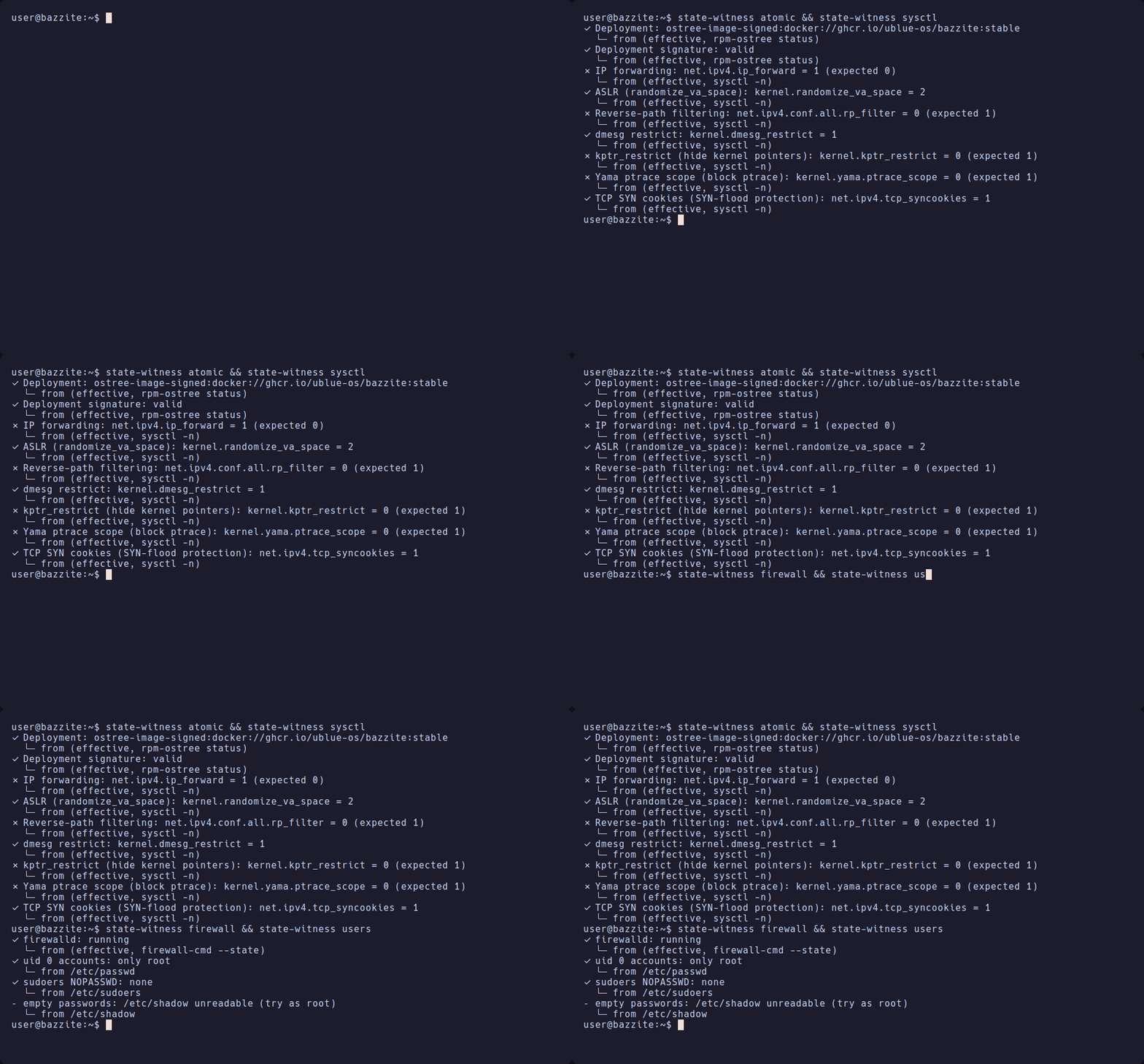
state-witnessOpen source. github/state-witness ↗
Shows: checks against what the host enforces —
sshd -T,
sysctl, firewall, users — each finding naming its source.
Does not show: remediation, SARIF, or compliance mapping, and the README says so.
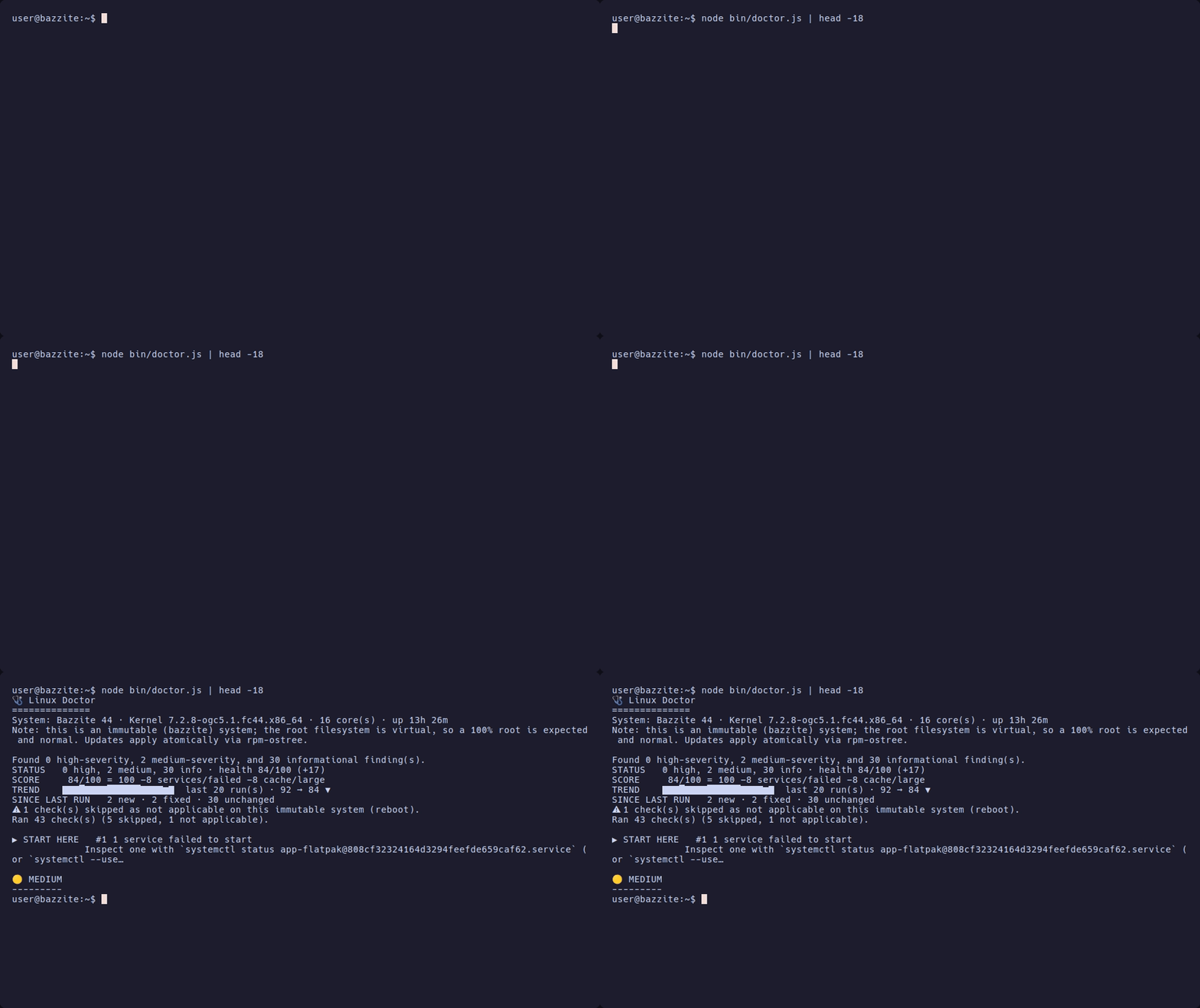
linux-doctorOpen source. github/linux-doctor ↗
Shows: read-only checks with plain-language explanations, history diffing, and a dry-run fix plan.
Does not show: automatic repairs —
--fix only prints a plan, and applying it needs a second explicit opt-in.
n8n labLab. Summary and one illustrative graphic on the work page ↗
Public: a written summary and one illustrative graphic of the workflow graph.
Not public: the compose file, exported workflows and logs — nothing that would let you reproduce or independently verify the setup.
Does not show: that the installation or the workflows were validated by anyone else. The graphic is illustrative, not a reproduction artifact.
MCP poisoning labLab. Read it ↗
Shows: a poisoned tool description reaching the model's context through the catalog, captured as output, and a scanner that flags it.
Does not show: a model obeying the instruction — that would need tool-call logs, which the lab did not capture.
mcp-tool-scannerOpen source. github/mcp-tool-scanner ↗
Shows: catalog validation, keyword signals with exit codes, and a documented list of false positives and negatives.
Does not show: that a server is safe — it is a review aid that reads the description field of the captured page.
Assessment only? Server Health Check · €49
I run linux-doctor and a manual pass on your server, and hand you a prioritized report: what is exposed, what matters, what to fix first — with the evidence behind each finding. Nothing on the system is changed, and implementing the fixes is not included. If you go on to hardening, the €49 comes off the price. It is an entry option, not a required step before hardening — you can start with any service.
./get-a-health-check